
Before We Cross
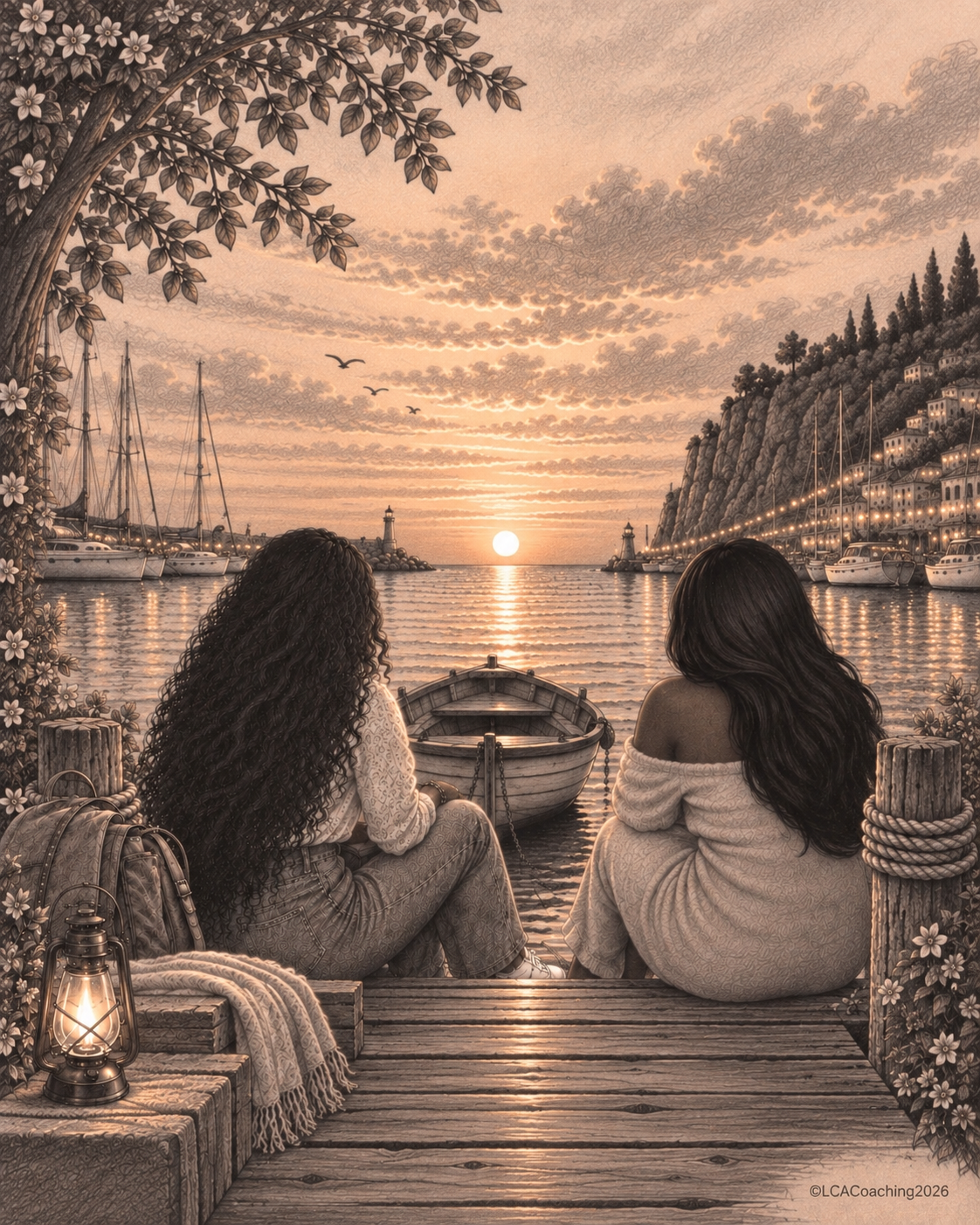
Before we begin this reflection, I want to start with the illustration.
This image is an ode to one of my oldest friends, someone with whom I have shared several crucial moments in life.
Over the years, we have found ourselves beside each other through decisions, changes, endings, beginnings and moments when neither of us could fully know what would come next.
So when I imagined The Crossing, I wanted a piece of that friendship to live here too.
Because although the decisions we make are ultimately our own, we do not always arrive at life's crossings alone.
Sometimes someone sits beside us for a while.
They listen. They witness. They remind us who we are. They may offer their perspective without choosing for us. And sometimes, their presence simply makes it a little easier to sit at the edge long enough to hear ourselves think.
This is a fitting place to begin our reflection on conscious choice.
Because before we cross, there is often a moment at the water's edge.
A moment to pause. To look at where we have been. To look at what lies ahead.
And to ask ourselves:
What am I actually choosing?
Before a decision becomes a decision
There are moments in life when we find ourselves standing at the edge of something.
A relationship. A new opportunity. A conversation we know we need to have.
A move. A boundary. An ending. A beginning.
Sometimes we have been walking toward that moment for a long time. At other times, life seems to bring us there unexpectedly. And suddenly, there is a choice in front of us.
We often think of decisions as the moment we finally say yes or no. The moment we stay or leave. Accept or decline. Begin or end.
But there is also everything that happens before that moment.
The wondering. The weighing. The conversations. The quiet knowing we may not yet have words for.
The part of us that is ready. And perhaps another part that is still afraid.
Before we cross, there is room for all of it.
We do not have to rush ourselves toward an answer simply because we have arrived at the water.
Sometimes we need to sit there for a while.
What is sitting beside us?
We rarely arrive at an important decision empty-handed. We bring our experiences with us.
Our hopes. Our fears. Our responsibilities. Our values. Our expectations. The people we love.
The things we have learned. And sometimes the things we are still learning to let go of.
All of these can find their way into the choices we make.
Sometimes we also bring old ways of protecting ourselves with us. Ways of responding that may once have helped us feel safe, avoid rejection, keep the peace or make our way through difficult circumstances.
A conscious decision does not require us to somehow remove all of these influences before we choose.
That may not even be possible. It asks us to notice them.
To become curious about what is sitting beside us at the water's edge.
What part of me wants to cross?
What part of me wants to stay?
What am I afraid might happen if I choose this?
What am I afraid might happen if I don't?
Whose disappointment am I trying to prevent?
What am I hoping this decision will give me?
What might it ask from me in return?
And underneath all of that:
When the noise settles, what feels true for me?
Sometimes we say yes because something genuinely feels right for us.
Sometimes we say yes because saying no feels difficult.
Sometimes we stay because there is still something meaningful to stay for.
Sometimes we stay because leaving feels frightening.
Sometimes walking away is an act of courage.
And sometimes staying long enough to have the conversation is.
The choice itself does not always tell us what is underneath it.
That is why it can be helpful to become curious before we move.
There may not be one perfect answer waiting for us.
But slowly, we may begin to hear ourselves more clearly.
Sometimes both shores matter
Every yes contains a no. Not every decision comes with an obvious right and wrong choice.
Choosing one direction often means not choosing another.
That does not automatically make the other direction wrong.
Sometimes there is something meaningful on both sides.
We may feel excited about what lies ahead and still feel sad about what we would leave behind.
We may know that something needs to end and still cherish what it once gave us.
We may choose a new direction and still wonder about the road we did not take.
There can be grief inside a good decision. There can be uncertainty inside a thoughtful one.
There can even be love for something we know we can no longer choose.
We can choose ourselves and still feel the weight of someone else's disappointment.
We can make the right decision for this season of our lives and still wonder occasionally what would have happened if we had chosen differently.
Perhaps conscious choice is not about making all of those feelings disappear.
Perhaps it is about allowing them to sit beside us while we decide.
To acknowledge what each direction carries.
What we may gain. What we may lose. What we are ready for. What we are no longer willing to carry.
And what, at this point in our journey, matters enough to move toward.
We are allowed to take our time
There can be so much pressure around decisions.
Have you decided yet?
What are you going to do?
What are you waiting for?
Sometimes a decision genuinely needs to be made quickly.
But not every pause means we are stuck. Sometimes the pause is where clarity begins.
We may need more information. Another conversation. A little distance.
We may need time to notice our body's response. To separate fear from intuition. To distinguish what we want from what others want for us. To understand what a choice may require practically, emotionally or relationally.
Perhaps we need a quiet evening. A prayer. A page in a journal. A walk.
Or simply enough time for the first wave of emotion to settle.
We may need to hear the opinions of people we trust and then spend some time noticing what remains when their voices become quiet again.
We do not always need to turn uncertainty into immediate action.
Taking our time does not guarantee that we will eventually feel completely certain.
It simply gives us the opportunity to meet our decision with greater awareness.
We do not have to sit at the water alone
Some of the most important decisions in our lives may be ours to make, but that does not mean we have to carry them alone. Sometimes we need someone beside us.
Someone who listens without immediately telling us what to do.
Someone who knows enough of our story to understand why this moment matters.
Someone who asks a question we had not considered.
Someone who gently reminds us of something we once said mattered to us.
Someone who can sit with our uncertainty without rushing us out of it.
They cannot make the crossing for us. And they cannot promise us what we will find on the other side.
But they can sit beside us while we look across the water.
There is something deeply valuable about being accompanied without being directed.
To be supported while still being trusted with our own life.
Eventually, the choice remains ours. But for a little while, someone may simply sit beside us.
We cannot see everything from the shore
Even after we have taken the time to reflect, there will still be things we cannot know.
We cannot see every part of the journey from where we are sitting.
We cannot know exactly how another person will respond. We cannot predict every consequence.
We cannot guarantee that what looks right from this side of the water will unfold exactly as we imagined.
That uncertainty can make choosing difficult.
We may find ourselves waiting for a level of certainty that life cannot always give us.
But making a conscious decision does not mean knowing everything.
It means allowing ourselves to look carefully at what we do know.
What matters to us. What we need. What we value.
What we have learned. What feels possible. What no longer feels right.
And what we are willing to choose with the understanding we have today.
Sometimes certainty never arrives. Instead, we may become clear enough about our values, needs, boundaries and circumstances to say:
Given what I know now, this is the direction I am willing to choose.
Sometimes that is the clarity available to us.
And sometimes, that is enough.
And then, we cross
There may eventually come a moment when we have sat at the water long enough.
Not because every question has been answered. Not because every fear has disappeared.
Not because someone has guaranteed that everything will work out.
But because something within us has become clear enough to move.
We look behind us. We look across the water. We listen once more. And then we choose.
Perhaps the words are simply:
This matters to me. This is what I know. This is what I am ready to leave behind. This is what I want to move toward.
And with what I know today, this is the direction I choose. Then we step into the boat.
Not because someone pushed us from the shore. Not because everyone else was already crossing.
Not because we had to prove that we were brave enough to go.
But because the choice has become ours.
And we are ready to carry it.
Before you cross
If you are sitting at a crossing of your own right now, there may be no need to get into the boat just yet.
Stay at the water's edge for a moment. Look at what is behind you. Look gently toward what may be ahead.
And notice what comes up when you ask yourself:
What am I actually choosing?
What matters to me here?
What am I hoping this choice will make possible?
What might I have to leave behind?
Which voices am I carrying into this decision?
And when the noise settles, what feels true for me?
You do not have to cross simply because you have reached the water.
There is room to sit. To wonder. To talk. To listen. To change your mind.
And when it is time to move, you may still not know exactly what is waiting on the other side.
You may simply know that you have taken the time to meet this choice with care.
And then, when you are ready,
you cross.
