
We Meet in the Light
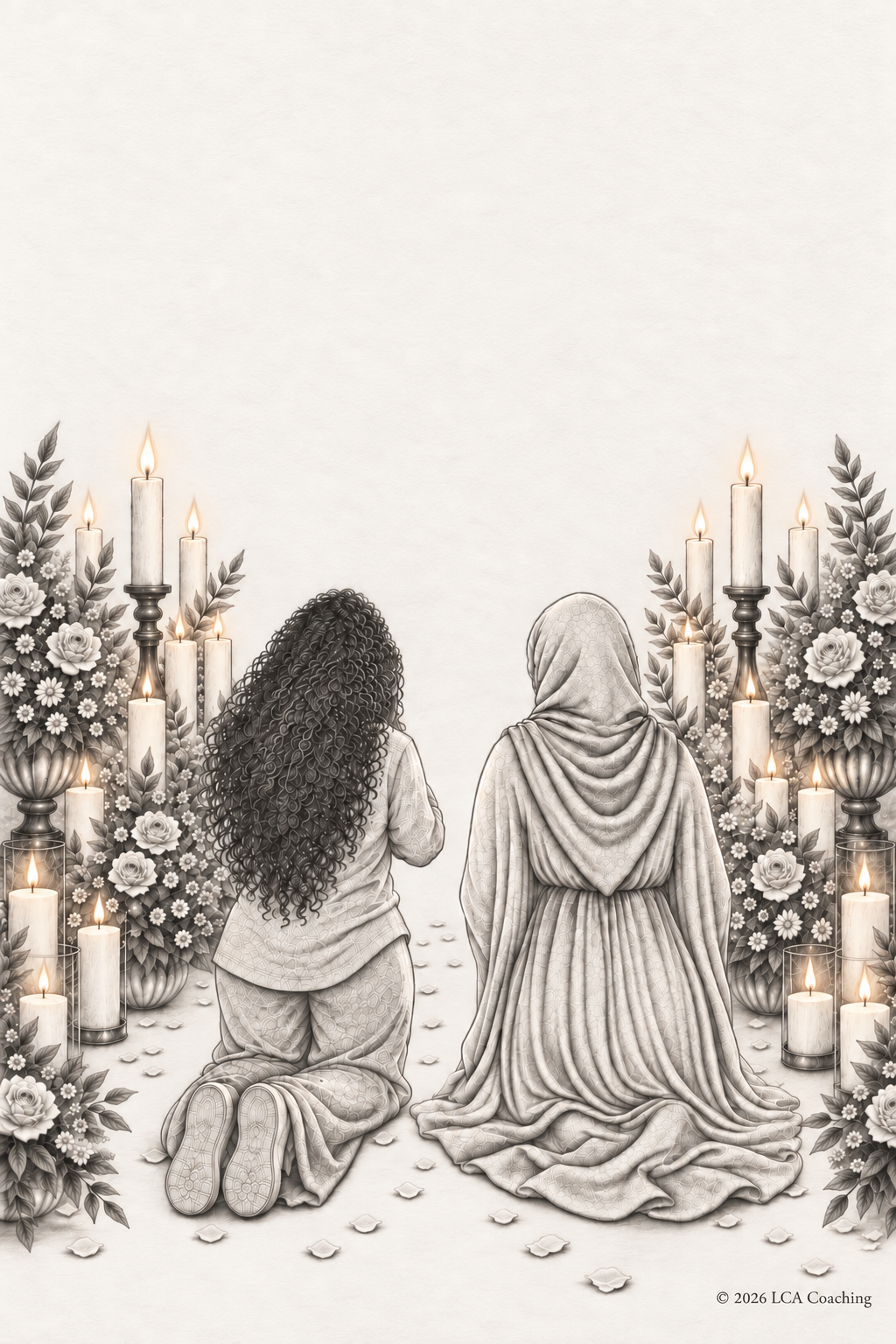
One of my oldest friendships began when she was about sixteen. Since then, life has taken us through so many different seasons. I have had the privilege of watching her grow into the woman she is today, just as she has witnessed so much of my own becoming. There is something deeply precious about having known and loved someone through so many versions of who you have both been.
She is a devoted Muslim. I am a Christian. Our faiths are different. And throughout all these years, I have never needed her faith to look like mine in order to recognize something beautiful in the way she lives it.
She is a bright light. One of the purest people I know. I deeply respect her devotion, her sincerity and the way she tries to embody what she believes in the way she moves through the world.
This contemplation is an ode to her and to the bond we share. But it is also about something I have come to understand through many of the friendships in my life.
I have friends from different cultures, backgrounds and religious traditions. Some are Muslim. Some are Buddhist. Some are Hindu. Some experience faith or spirituality very differently from me.
Loving people who are different from us can be beautiful. But it is not always simple.
Sometimes, our differences ask us to learn how to live alongside one another in ways we may not have had to think about before.
When our differences become real
It can be relatively easy to appreciate our differences when they do not ask anything difficult of us.
But sometimes they enter the relationship. They show up in our celebrations, our traditions, our expectations, our boundaries and in what we ask of one another.
Culture can shape what friendship, family, celebration, care and showing up for one another look like.
Religion can shape what we participate in, which spaces we enter, which rituals we take part in and what we feel able to do while remaining faithful to what we believe.
And sometimes, two people who genuinely love each other can find themselves standing on different sides of something that matters deeply to both of them.
Imagine someone we love is getting married in a place of worship belonging to a different religion.
For one of us, being there may feel like the most natural expression of love:
Of course I will be there. You are my friend.
For another, entering or participating in worship connected to another deity may go against a deeply held religious conviction.
One of us may be thinking:
If I matter to you, why wouldn’t you be there?
While the other may be thinking:
I love you deeply. But I cannot meet you there without crossing something sacred to me.
That can hurt. And the hurt is allowed to be there.
But someone’s no is not always a measure of how much they love or value us.
Sometimes, we are encountering an existential conflict. The relationship matters. And what we believe matters.
Both can be true at the same time.
Holding two realities
Sometimes the difference between us is not only in our beliefs or cultures, but in our capacity.
In some cultures, a wedding is celebrated for several days. Being present throughout those days can mean much more than simply attending a celebration. It can represent love, family, belonging and showing someone:
I am here with you.
But someone we love may be neurodivergent, and prolonged social events may leave them deeply overstimulated. Even getting there may ask more of them than we realize. Travelling, navigating unfamiliar environments, changes in routine, being around many people and processing everything that comes with it can already take a great deal of energy.
One of us may be feeling:
This is one of the most important moments of my life. I want you here with me.
While the other may be feeling:
This matters to me too. I love you. And I cannot physically or emotionally sustain everything that being there asks of me.
Neither person has to be wrong.
Two different realities can exist at the same time.
Sometimes someone cannot show up for us in the way we hoped, not because they care less, but because showing up asks something of them that we cannot see from the outside.
Understanding why something matters to someone does not automatically give us the capacity to give it to them.
And having less capacity does not make our love less real.
This can be difficult, especially when showing up is one of the ways we recognize love. We may feel disappointed. We may miss someone. We may wish they could give us more. Those feelings are allowed to exist too.
But we can become curious about the difference between unwillingness and limited capacity.
Instead of only asking:
Why aren’t you showing up for me?
We can also ask:
What does showing up ask of you?
And from there:
What does respecting both people’s autonomy look like here?
Learning to live together without requiring sameness
The people we love are their own people. They carry their own stories, cultures, beliefs, bodies, capacities, values and boundaries. And so do we.
Connection does not make those differences disappear. Sometimes, it brings us close enough to truly encounter them.
We may wish someone could meet us somewhere they cannot.
We may feel disappointed by a boundary even while understanding why it exists.
Something that feels completely comfortable to us may cross a religious boundary for someone else.
Something that means love within our culture may ask more of someone than they are able to give.
Something we experience as inclusion may ask another person to participate in something they do not feel able to participate in. These moments can be tender.
Respecting each other’s autonomy does not mean we stop having feelings about each other’s choices.
It means those feelings do not give us the right to ask someone else to abandon themselves.
Sometimes, we course-correct
We are not always going to know where every boundary is. Sometimes we discover one by bumping into it.
We may ask something without realizing what it means to the other person.
We may make an assumption based on our own culture, faith or way of experiencing the world.
We may not realize how much something asks of someone else. We may misunderstand each other.
We may unintentionally hurt each other. And sometimes, we will have to course-correct.
We can slow down and listen.
We can ask:
What did this mean to you?
And share:
This is what it meant to me.
We can become curious about the space between those two experiences.
Sometimes we realize that we could have approached something differently. Sometimes we need to apologize.
Sometimes a boundary remains exactly where it is, but we understand it better now.
And sometimes, together, we find another way.
We may not be able to attend every day of the celebration, but we can be there for one meaningful part.
We may not be able to participate in a religious ritual, but we can find another way to celebrate someone we deeply love.
The way we first tried to show love may not have been a way the other person could receive it.
So we learn. We adjust. We try again. Not because the relationship has failed. But because knowing someone is an ongoing process.
Loving someone well sometimes means letting go of the idea that love must always look the way we expected it to look.
A boundary does not necessarily mean:
I don’t love you.
Sometimes it means:
I love you. And I cannot meet you there. Can we find somewhere else to meet?
The Inner Cathedral
This is part of what the Inner Cathedral in LCA World represents. The Inner Cathedral is not tied to one faith tradition. It is a symbolic space for exploring what is sacred and meaningful to you, and what gives direction to your life.
A place within ourselves where we become still enough to ask:
What gives direction to my life?
What do I believe?
What do I value?
What do I want to remain faithful to?
For me, inner guidance is deeply anchored in my relationship with God and my Christian faith.
For someone else, what gives their life meaning and direction may be different.
The Inner Cathedral does not ask us to erase those differences.
It gives us space to become quiet enough to listen to what guides us, to explore what is sacred to us and to discern what helps us live with greater dignity, integrity and purity.
There is something important in allowing the people beside us that same space.
We do not have to believe what they believe in order to understand that their convictions may be deeply meaningful to them. We do not have to make ourselves smaller to make room for another person.
And they do not have to make themselves smaller to make room for us.
We can remain rooted in what gives our own lives direction while allowing the people we love to remain rooted in theirs.
This is what harmony can look like
Harmony does not require a life without differences. It does not require a relationship without tension.
Harmony can also live in the way we care for each other when our differences become real.
When we listen after a misunderstanding. When we ask instead of assume.
When we respect a boundary we might not personally need.
When we recognize that someone may not have the same capacity we do.
When we allow a no to remain a no, even when we wish the answer had been different.
When we make room for disappointment without turning it into pressure.
When we realize we got something wrong and course-correct.
When we keep looking for ways of loving one another that allow both people to remain whole.
We will not always get it right.
Sometimes there will be an easy compromise. Sometimes there will not.
Sometimes we will need time. And sometimes we will have to accept that there is a place where someone we love simply cannot meet us.
The question then becomes:
Can we remain in relationship without requiring one another to abandon ourselves?
We do that not by pretending our differences do not matter, but by learning what they mean to each other.
By staying curious. By listening. By allowing difference to exist without requiring sameness.
Where can we meet?
Throughout our lives, we will meet people whose beliefs, cultures, histories, capacities and ways of seeing the world are different from ours. Some of them will become deeply precious to us.
My friend and I will not meet in every belief. We do not need to.
And the same is true of many of the people I love.
There may be places where we cannot meet.
There may be boundaries we need time to understand.
There may be moments when we have to stop, listen, adjust and find another way.
But connection does not require us to meet everywhere.
We can keep looking, with care and respect, for the places where we can.
We don’t have to leave what is sacred to us at the door in order to make room for what is sacred to someone else.
We can remain rooted in what gives our own lives direction while allowing the people beside us to remain rooted in theirs. We can learn each other. We can make room for each other. We can course-correct when we need to.
And when there is somewhere we cannot meet, we can gently ask:
Where can we meet?
Another person does not have to see the world exactly as we do for us to recognize the light in them.
We don’t always have to meet in agreement.
Sometimes, we meet in the light.
