
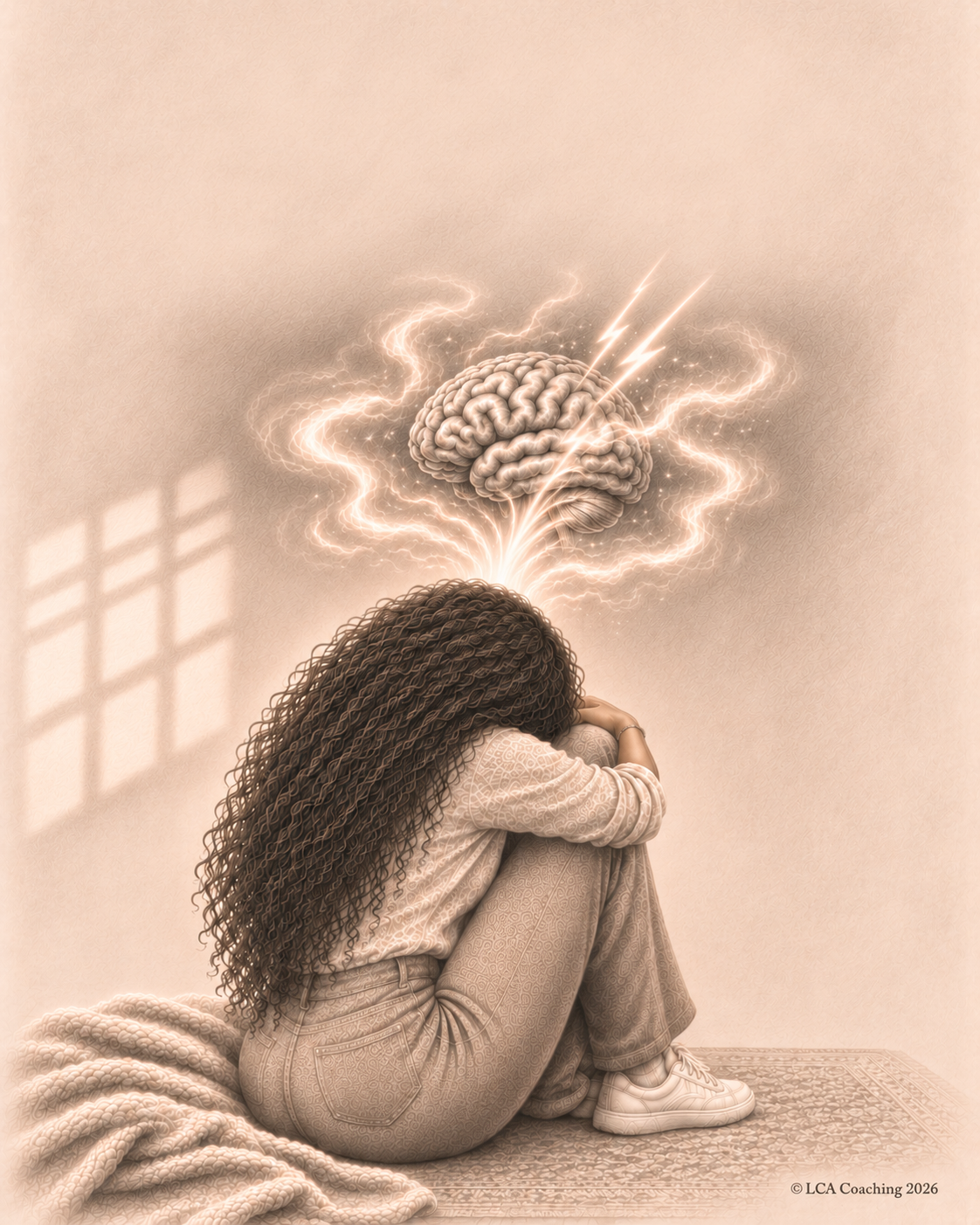
LCA Beyond the Stereotype: Understanding the invisible experiences behind autistic overwhelm.
What Happens Beneath the Surface
Imagine walking into a room.
Someone notices you entering. You don't greet them. You don't make eye contact. Perhaps you appear distant, distracted, or uninterested.
To the person watching, your behavior might seem rude.
“Why didn't they say hello?”
“Are they deliberately ignoring me?”
“Do they think they're better than everyone else?”
But what if you haven't even noticed them?
For me, entering an unfamiliar environment can feel like an assault on my brain.
There's so much information coming in at once. The conversations, the background noise, the movement, the lighting, the smells, the people, the atmosphere. My brain is trying to take it all in, process what's happening around me, and establish whether I feel safe.
And while all of that is happening, I might genuinely not notice someone standing right in front of me. Yet someone else may interpret that moment as disrespect. They see someone who didn't acknowledge them.
What they don't see is a brain working incredibly hard to process an unfamiliar environment. And that's where misunderstandings can begin.
For some autistic people, everyday situations involve layers of sensory, cognitive, and emotional processing that others may never have to consciously think about.
Someone can appear independent, articulate, socially capable, and professionally successful while still experiencing significant difficulties with unexpected changes, sensory stimulation, communication, or emotional regulation.
Sometimes, the more capable someone appears, the less likely others are to recognize when they're struggling.
Being able to function doesn't necessarily mean functioning comes easily.
And when those invisible difficulties eventually become visible, people may interpret them without understanding what came before.
What looks like arrogance may be overwhelm. What looks like inflexibility may be a need for predictability. And what appears to be unwillingness to communicate may be someone struggling to access spoken words under pressure.
When You Feel Something but Don't Know What You're Feeling
Recognizing emotions is a skill I had to learn. For a long time, I struggled to identify what I was feeling. I could notice physical discomfort or changes in my mood without understanding the emotions behind them.
It was only through reflection afterwards that I began to understand what I had been experiencing.
Learning to recognize these signals has helped me better understand my emotions and what I need.
Two psychological concepts can help explain why recognizing emotions isn't equally straightforward for everyone.
Our bodies give us signals throughout the day. We notice when we're hungry, when our heart beats faster, or when tension builds in our shoulders.
The ability to notice and interpret these internal signals is called interoception.
But knowing what's happening in your body doesn't always mean knowing what you're feeling.
You might notice your heart racing without knowing whether you're anxious, excited, or upset.
Difficulty recognizing and describing emotions is called alexithymia.
Although these experiences can be connected, they're not the same. You can recognize physical sensations without understanding the emotions associated with them.
Research by Bird and Cook (2013) highlights that alexithymia and autism are distinct. Although alexithymia can occur alongside autism, not every autistic person experiences it.
For some people, recognizing emotions takes time, reflection, and practice. And having difficulty identifying a feeling doesn't mean experiencing it any less deeply.
When Everyday Demands Become Overwhelming
An ordinary working day can involve countless small demands on our attention. A phone call, an unexpected question, a change in priorities, or someone needing assistance may seem relatively manageable when considered individually.
But when these demands continue throughout the day, their cumulative impact can be significant.
For some autistic people, the challenge isn't necessarily the amount of work itself. It's the constant need to switch between tasks, process new information, and adapt to changing expectations.
I recognize this in the way I work. When I'm concentrating, I need structure and continuity. I function best when I can organize my responsibilities and complete what I've started before moving on to something else.
It doesn't mean I'm unwilling to help someone. I may be perfectly happy to support another person once I've finished what I'm doing. But when interruptions happen continuously, I can lose the structure that helps me process information effectively. Finding my way back into a task isn't always as simple as picking up where I left off.
This is partly related to executive functioning, the mental processes that help us plan, organize information, maintain attention, and switch between tasks.
Some autistic people experience differences in these abilities, although the challenges vary considerably between individuals.
For someone who finds task-switching demanding, frequent interruptions can require substantial additional mental effort. Yet the need for structure is sometimes interpreted as inflexibility.
A person who prefers completing one task before starting another may be perceived as uncooperative. Someone who requests predictable routines may be encouraged to become more adaptable.
These interpretations overlook the practical purpose structure can serve.
Predictability may help someone concentrate, manage responsibilities, and process information without becoming unnecessarily overwhelmed. What feels like flexibility to one person may feel like continuous disruption to another.
Rather than assuming that someone needs to become less dependent on structure, it may be more helpful to explore which working conditions allow them to function effectively.
When Speaking Up Doesn't Feel Safe
Growing up, speaking up for myself didn't always feel safe. I have always been outspoken and direct, something that can be part of how autism influences communication. However, my directness wasn't always understood the way I intended, sometimes leaving me feeling misunderstood or unheard.
Over time, I began associating speaking up with the possibility of conflict, criticism, or rejection. And that fear didn't simply disappear as I got older. During difficult conversations, particularly when I needed to stand up for myself or communicate a boundary, I could feel the tension building in my body.
Sometimes, I would stumble over my words. Other times, the tension became so overwhelming that I couldn't speak at all. I knew what I wanted to say, but I couldn't get the words out. It felt like I was trapped inside my own mind, trying to communicate something I couldn't physically express.
And when my silence was interpreted as an unwillingness to communicate, the pressure only increased. It was only when that tension began to ease that I gradually regained my ability to speak.
For some autistic people, intense stress or overwhelm can temporarily affect their ability to speak. This experience is often described as an autistic verbal shutdown.
During a verbal shutdown, spoken communication may become inaccessible, even though the person still wants to communicate. As the overwhelm subsides, their ability to speak may gradually return.
A review by Oldenburg and colleagues (2026) explored how autistic people's communication can change during periods of distress, including difficulties with verbal expression and the ways others can offer support.
Giving someone time, reducing pressure, or offering another way to communicate, such as writing, can help make these situations more manageable.
When Your Behavior Is Misunderstood
Much of our everyday communication depends on social expectations. These expectations can become so familiar that we rarely question them. But social behavior doesn't always carry the same meaning for everyone.
Someone who avoids eye contact, for example, may be perceived as uninterested, dismissive, or disrespectful. Yet for some autistic people, maintaining eye contact requires conscious effort and can become uncomfortable, particularly during periods of sensory or emotional overload.
I learned to make eye contact because I understood that it was socially expected. Most of the time, I can do it.
But when I'm overwhelmed, maintaining eye contact can become another demand on a brain that's already processing too much information.
Sometimes, looking away simply makes the interaction more manageable.
The Invisible Cost of Masking
Autistic masking, sometimes called camouflaging, involves adjusting or hiding certain autistic characteristics to meet social expectations. This may include consciously maintaining eye contact, rehearsing conversations, monitoring facial expressions, or suppressing natural responses. Over time, some autistic people learn to adapt their behavior by observing how others communicate and interact.
In a study involving 92 autistic adults, Hull and colleagues (2017) explored how masking could help people navigate social situations and build connections, but also come at a cost.
Participants described exhaustion and difficulties with their sense of identity.
As a result, someone may appear confident and socially comfortable while putting considerable effort into meeting expectations that don't come naturally to them.
What others see is how well someone adapts, not necessarily how much it takes out of them.
When Being Different Becomes the Problem
Social differences can sometimes become the basis for negative assumptions about someone's character. A person may communicate more directly, require additional processing time, or respond differently to social situations. Rather than exploring what might contribute to those differences, others may interpret them through their own expectations.
Over time, labels can begin to emerge. “Difficult. Rude. Too sensitive. Inflexible. Arrogant.”
Once someone has been labeled, even ordinary behavior can begin to be interpreted negatively.
Asking for clarification may be seen as challenging authority, a need for structure as stubbornness, or expressing discomfort as overreacting.
These assumptions can shape how others treat that person. What begins as a misunderstanding can develop into exclusion, ridicule, or even bullying.
And when someone is repeatedly judged for being different, they may find themselves in an environment where they no longer feel safe being themselves.
When Being Different Becomes the Joke
Sometimes, the way someone communicates, responds, or behaves becomes a source of amusement for others.
A person might miss a social cue, interpret something literally, or respond differently than expected. What feels natural to them may seem unusual or funny to someone else.
Humor can bring people together, but it can also become a way of making someone feel embarrassed, excluded, or humiliated. And when that person expresses discomfort, they may hear a familiar response:
“It was just a joke.”
Not every joke is intended to cause harm. People don't always realize when their humor has crossed a boundary.
But when someone makes it clear that they're uncomfortable, dismissing their feelings only adds to the hurt.
There's a difference between sharing a moment of laughter and taking pleasure in someone else's discomfort or humiliation.
When Differences Are Treated as Something to Correct
Sometimes, people interpret unfamiliar social behavior as something that needs to be corrected. Someone may communicate more directly than expected, ask questions to better understand a situation, or respond differently to social expectations.
Rather than trying to understand these differences, others may interpret them as disrespect, defiance, or unwillingness to cooperate. And sometimes, this leads to people responding with unnecessary harshness, as though the person needs to be taught a lesson.
But there's a difference between offering constructive feedback and belittling someone for being different. We all have responsibilities in how we communicate and treat others. Being autistic doesn't mean our behavior can't affect someone else or that we shouldn't be open to feedback.
However, addressing someone's behavior doesn't require intimidation, ridicule, or humiliation.
Accountability and dignity don't have to compete.
Understanding the Double Empathy Problem
In 2012, autism researcher Damian Milton introduced the concept of the double empathy problem.
It challenges the idea that communication difficulties between autistic and non-autistic people are always caused by the autistic person's way of communicating.
Instead, misunderstandings can arise because people experience, express, and interpret things differently.
For example, an autistic person may communicate directly because they value honesty and clarity, while someone else interprets that directness as rude or unfriendly.
Neither person may fully understand how the other experiences the interaction.
The double empathy problem reminds us that understanding is a two-way process.
Rather than expecting one person to do all the adapting, it encourages both people to recognize that their way of communicating isn't necessarily the only way.
Understanding one another often begins with curiosity about how someone else experiences the world.
When Distance Is Mistaken for Disrespect
Feeling safe with someone is essential for me to build a meaningful connection. When I feel safe, I can open up, communicate freely, and be myself.
But when that sense of safety is missing or inconsistent, I create distance.
Not because I believe I'm better than someone or because I'm trying to punish or reject them, but because my emotional well-being is my priority.
When Past Experiences Shape Our Sense of Safety
For some autistic people, social interactions can involve considerable uncertainty. Unspoken expectations, unpredictable responses, sensory demands, or previous experiences of being misunderstood can make it difficult to feel comfortable around others.
When someone has repeatedly encountered criticism, rejection, or negative interpretations of their behavior, they may become more attentive to signs that similar experiences could happen again.
This can influence how safe they feel expressing themselves, particularly in unfamiliar environments or around people whose reactions they cannot easily anticipate.
Of course, someone on the receiving end of that distance may genuinely feel rejected. Their feelings matter, too.
But creating distance doesn't always mean rejecting someone. Sometimes, it's simply what someone needs to feel safe.
When Overwhelm Becomes a Meltdown
Sometimes, overwhelm builds so gradually that I don't immediately recognize how close I am to reaching my limit.
I may have been dealing with unexpected changes, constant interruptions, sensory stimulation, or emotionally demanding situations throughout the day.
Each experience requires energy, and eventually, even a small additional demand can become too much.
When I reach that point, the tension in my body can become so intense that thinking clearly, communicating, or regulating my emotions becomes incredibly difficult.
To someone watching, my reaction may seem disproportionate to what just happened.
But what they're seeing is the result of everything that has been building up.
An autistic meltdown is an intense response to overwhelming sensory, emotional, or cognitive demands.
During a meltdown, someone may temporarily lose some of their usual ability to regulate their emotions or behavior.
This can involve crying, becoming visibly distressed, struggling to process information, or feeling an urgent need to escape the situation.
Meltdowns are not deliberate attempts to gain attention or manipulate others.
In their 2023 study, Lewis and Stevens explored how autistic adults experience meltdowns.
Their research draws attention to the intensity of these experiences and the importance of understanding them from the perspective of the person experiencing them.
Rather than focusing only on someone's visible reaction, it can help to consider the demands that preceded it.
Giving someone space, reducing stimulation, and avoiding additional pressure may help them regain a sense of calm.
People often see the moment someone reaches their breaking point. What they don't see is everything that person has been carrying before getting there.
When Coping Becomes Surviving
I've experienced periods when the unpredictability of everyday life became increasingly difficult to manage.
Sometimes, it was something as simple as discovering that my usual supermarket was temporarily closed. Other times, it involved being harassed on the street or navigating difficult interactions at work.
These unexpected experiences would gradually build up throughout the week, leaving me physically and mentally exhausted by the weekend.
As the tension accumulated, I began struggling with things I would normally manage. I was late for appointments, had difficulty keeping up with my responsibilities, and found myself increasingly unable to function the way I used to.
I kept trying to adapt, meet expectations, and find ways to cope, until I eventually burned out.
The accumulated stress had become more than my body could handle, and I needed months to recover.
Understanding Autistic Burnout
Autistic burnout is a prolonged state of exhaustion that can develop when the demands of everyday life repeatedly exceed an autistic person's capacity and available support.
In a 2020 study, Raymaker and colleagues explored the experiences of autistic adults and identified three common characteristics: severe and persistent exhaustion, reduced ability to perform activities or use skills that were previously manageable, and increased sensitivity to sensory stimulation.
Autistic burnout can therefore affect much more than someone's energy levels. Everyday activities such as concentrating, communicating, organizing responsibilities, or maintaining social interactions may become increasingly difficult.
Unlike temporary overwhelm, autistic burnout can last for months or longer, and recovery may require significant changes to someone's daily life.
The research also highlights the role of chronic stress, insufficient support, and the constant pressure to adapt to environments that don't always accommodate autistic needs.
Sometimes, recovery requires more than rest. It may also mean reducing demands, creating greater predictability, and finding a more sustainable balance between expectations and personal capacity.
When Other People's Coping Strategies Don't Fit
When someone becomes overwhelmed, people often want to help by suggesting strategies that have worked for them.
Breathing exercises, meditation, or physical activity can be helpful, but what works for one person doesn't necessarily work for another.
I've experienced this myself. When my brain is already overwhelmed, even something as simple as counting my breaths can become another task I struggle to process.
That doesn't mean breathing techniques are ineffective. It means finding what works for you depends on your needs and circumstances.
Learning to Understand What You Need
Learning more about autism has helped me understand myself in ways I couldn't before. I've become more aware of what overwhelms me, what helps me feel safe, and what I need to function comfortably.
Sometimes, that means approaching situations differently. Other times, it means recognizing when an environment simply isn't right for me.
And perhaps one of the most meaningful parts of that journey has been learning to see myself beyond the labels and expectations of others.
Because understanding ourselves doesn't mean every challenge disappears. It means we can begin making choices from a place of understanding rather than confusion.
Before You Go
Think back to the person who entered the room without saying hello.
Now that you've seen beyond the stereotype, could you interpret that same person differently?
Research & Further Reading
Emotional Awareness and Alexithymia
Bird, G., & Cook, R. (2013). Mixed emotions: The contribution of alexithymia to the emotional symptoms of autism. Translational Psychiatry, 3, e285.
DOI: 10.1038/tp.2013.61
Autistic Masking and Camouflaging
Hull, L., Petrides, K. V., Allison, C., Smith, P., Baron-Cohen, S., Lai, M.-C., & Mandy, W. (2017). “Putting on My Best Normal”: Social Camouflaging in Adults with Autism Spectrum Conditions. Journal of Autism and Developmental Disorders, 47, 2519–2534.
DOI: 10.1007/s10803-017-3166-5
The Double Empathy Problem
Milton, D. E. M. (2012). On the ontological status of autism: The ‘double empathy problem’. Disability & Society, 27(6), 883–887.
DOI: 10.1080/09687599.2012.710008
Communication During Autistic Distress
Oldenburg, K., Gibbons, T., Welch, C., Tint, A., & Albin, M. (2026). Describing the communication of autistic people during experiences of distress: A scoping review. Autism, 30(4), 884–900.
DOI: 10.1177/13623613261417933
Autistic Meltdowns
Lewis, L. F., & Stevens, K. (2023). The lived experience of meltdowns for autistic adults. Autism, 27(6), 1817–1825.
DOI: 10.1177/13623613221145783
Autistic Burnout
Raymaker, D. M., Teo, A. R., Steckler, N. A., et al. (2020). “Having All of Your Internal Resources Exhausted Beyond Measure and Being Left with No Clean-Up Crew”: Defining Autistic Burnout. Autism in Adulthood, 2(2), 132–143.
DOI: 10.1089/aut.2019.0079
This article combines lived experience, psychological insights, and scientific research. Autism is experienced differently by every individual. The experiences described are not intended to represent every autistic person or serve as diagnostic criteria.
© LCA Coaching 2026
